2026 MEST Symposium
We are pleased to invite you to the 2026 MEST Symposium, titled “Emerging Communication Systems: from Cybersecurity to 6G and Quantum Networks.” This event brings together leading experts from industry and academia to explore the technologies defining the future of global connectivity. We are honored to host three distinguished speakers who will share insights into hardware security, the evolution of mobile standards, and the foundations of the Quantum Internet.
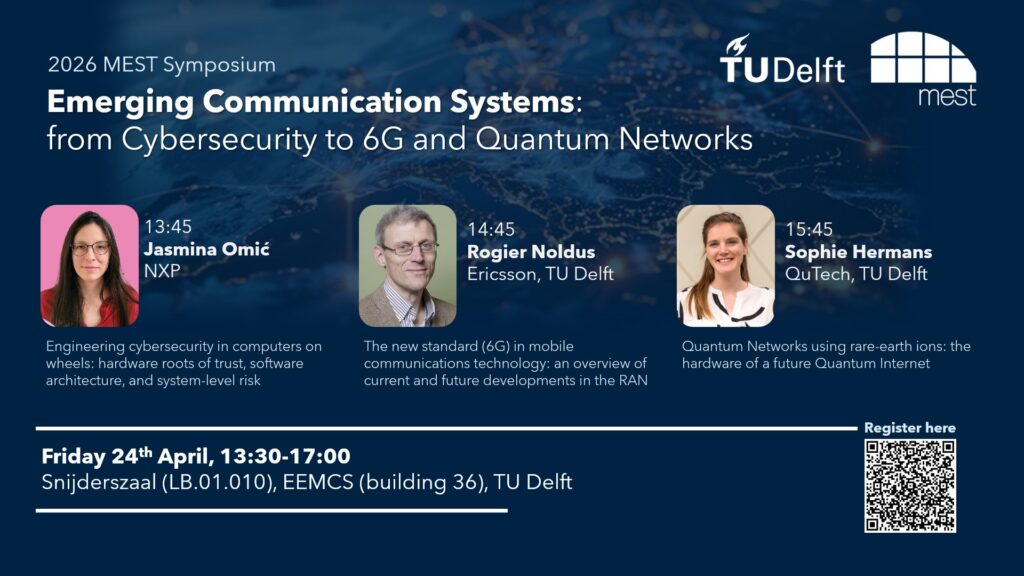
Please register for the symposium via the QR code on the attached flyer or through the link.
The speakers:
Dr. Jasmina Omić (13:45)
Bio: Jasmina Omić is a HW security architect at NXP Semiconductors in Delft, working on security architecture and secure‑by‑design approaches for embedded and semiconductor systems. She holds a PhD from Delft University of Technology, where her research focused on network epidemic spreading, and security game theory, with publications in leading IEEE and ACM venues.
Before joining NXP, Jasmina spent more than a decade at Riscure, occupying roles from security analyst, senior security analyst to product manager for security testing services, supporting global customers in automotive, IoT, and embedded security. Today, she combines deep technical expertise with a strong focus on cross‑disciplinary collaboration, and responsible adoption of new technologies in security engineering.
Talk: Engineering Cybersecurity in Computers on Wheels: Hardware Roots of Trust, Software Architecture, and System‑Level Risk
Abstract : This guest lecture presents an engineering view on cybersecurity in modern vehicles, understood as complex, safety‑critical cyber‑physical systems. It discusses how hardware roots of trust, software architecture, in‑vehicle communication, and lifecycle aspects such as updates and regulation jointly shape the automotive security. The lecture emphasizes threat modeling, architectural trade‑offs, and the key differences between automotive cybersecurity and conventional IT security.
Rogier Noldus (14:45)
Bio: Rogier Noldus works as a principal solution architect at Ericsson, focusing on the development of architecture for (mobile) communication systems. He contributed to the establishment of the standard for the mobile communications network (2G, 3G, 4G), specializing in Intelligent Networks. Rogier has subsequently specialized in multimedia communication systems (IMS, VoLTE) and the evolution towards the 5G network. Within the Dutch research project “Future Network Services”, Rogier is contributing to the definition of use cases for the 6G network. Rogier is also a part-time lecturer at TU Delft.
Rogier holds an MSc (Electrical Engineering) from the University of The Witwatersrand, Johannesburg, South Africa. Prior to joining Ericsson, Rogier worked at Siemens, Telkor, and Telephone Manufacturers (in South Africa).
Talk: The new standard (6G) in mobile communications technology: an overview of current and future developments in the RAN.
Abstract : We are on the eve of the development of a new generation mobile communication network: the 6G network. The step from 5G to 6G is not merely a “generation step”. 6G aims to be a fundamental innovation in network technology. In addition to the (obvious) higher data throughput and greater availability, 6G focuses on numerous application areas that go beyond the current (5G) network.
6G is not yet standardized. Many aspects of the 6G architecture are not yet known. But fundamental research into the possibilities is well underway. This research is taking place, among other things, within the Future Network Services (FNS) program. FNS is a Dutch research program with 60 participating organizations, including universities, research centers, network suppliers, and operators.
3GPP, the organization responsible for establishing the standard for the mobile communications network (GSM, 3G, 4G, 5G, 6G), has, in collaboration with the ITU-T, drawn up a number of functional requirements that the 6G network will have to meet. These requirements concern both the Radio Access Network (RAN) and the Core Network. These requirements are elaborated in detail in the 6G standard. It is anticipated that development within the 6G network will focus primarily on the radio network (the RAN). Security will be one of the leading requirements in the 6G development.
This presentation will take the audience through the ongoing development towards the 6G mobile communications network.
Dr. Sophie Hermans (15:45)
Bio: Sophie Hermans is Group Leader at QuTech. Sophie obtained her PhD degree here at TU Delft in the group of Prof. Hanson, focusing on quantum networks using nitrogen-vacancy centers in diamond. During her PhD, Sophie was appointed as one of the Faces of Science by the KNAW and served as an ambassador for inclusive science. For her postdoc, she moved to the California Institute of Technology (Caltech). Supported by the AWS Quantum Postdoctoral Fellowship, she was part of the group of Prof. Faraon and the Institute of Quantum Information and Matter (IQIM). In 2025, Sophie started her experimental research group at QuTech, and she has been awarded the NWO Vidi grant.
Talk: Quantum Networks using Rare-earth ions
Abstract : Secure online communication and browsing with full privacy? Those are two of the promises of a future Quantum Internet. Quantum communication, enabled by such networks, promises inherently safe communication, authentication, and private computations in the cloud.
My group’s research focuses on building the hardware for such quantum networks using rare-earth ions (REIs) in host crystals. REIs offer a versatile platform; their internal electronic configuration results in excellent coherence properties across a wide range of host materials, allowing for the freedom to design the hardware for a specific task or technology.
In this seminar, I will give an introduction to rare-earth ions doped in host crystals. Why are they appealing for quantum network nodes? I will discuss different REI demonstrations, involving ensembles and individual ions, and will share an outlook for the research here at QuTech/TU Delft.